
A quick reference to Skilled Reading, Scarborough’s Reading Rope, and The Active View of Reading
You don't need a literacy theory lecture. You need a fast, precise refresher that can provide shared vocabulary your team is likely using loosely to help you lead your district in literacy outcomes.
Why Reading is Complex
Skilled reading emerges from two interdependent strands: word recognition and language comprehension. They make different contributions to reading, but they work in concert, and a student can be strong in one while struggling in the other without anyone noticing, because most of what districts measure only looks at one side.
Word Recognition is the ability to read a word. It's phonemic awareness, phonics, decoding, and the fluency that comes from doing those things automatically enough that a reader isn't burning all their attention just sounding things out.
Language Comprehension is the ability to turn those words into meaning. It's vocabulary, syntax, background knowledge, verbal reasoning, and literacy knowledge, which are the tools a reader uses to connect ideas, track an argument, and understand what a text is actually saying.
A student can have excellent word recognition and still not understand what it means. A student can listen to a story and have key takeaways but, when faced with the words in front of them, can’t sound them out. Reading is complex, and word recognition and language comprehension must work together to help a student be skilled in reading.
What’s the Reading Rope?
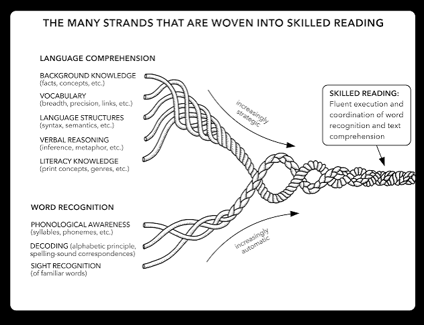 Reading researcher Hollis Scarborough gave the field a useful image for this in the 2001 model the Reading Rope. Picture two thick bundles of smaller threads twisting together into one cord.
- One bundle is word recognition: phonological awareness, decoding, sight recognition.
- The other is language comprehension: background knowledge, vocabulary, language structures, verbal reasoning, literacy knowledge.
Early on, these strands are looser and more visible on their own. As a reader develops, the rope is meant to tighten. Skilled reading isn't one strand finishing before the other starts. It's both strands braided together, and either one can stay thin indefinitely if it isn't deliberately taught.
Here's the part districts tend to miss: a tight rope requires tension from both sides, at every grade. If one strand is thin, the whole rope is weaker, even if the other strand looks strong on a screener. And a thin language comprehension strand is just as likely to show up in eighth grade as it is in second. Sofia, from the Closing the Comprehension Chasm: A Field Guide for District Leaders, shows this example. Her word recognition strand is tight. Her language comprehension strand never got the same attention.
What is the Active View of Reading?
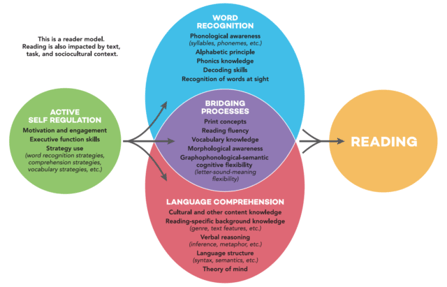 Duke and Cartwright's 2021 Active View of Reading was built to address what all happens when a student sits down to read, and it's worth knowing this model exists partly as a response to the Reading Rope. Some literacy researchers treat the two as genuinely different framings of skilled reading. You don't need to resolve that debate to use both models well, but your team should know it exists before someone in a PLC asks which one is "right."
In addition to the two components we’ve already discussed, word recognition and language comprehension, The Active View of Reading has two additional components:
- Bridging processes: strategy use, print concepts, reading fluency: the skills that connect recognition to comprehension in real time
- Active self-regulation: monitoring whether something makes sense, adjusting pace, catching your own confusion, and whether a reader is willing to do the effortful work a hard text requires
This is why two students can have identical vocabulary and decoding scores and still perform completely differently on the same passage. One is actively monitoring and adjusting. The other is moving through the text without checking whether it's landing. Read together, the two models tell you something the field guide leans on directly. Comprehension is not a switch that flips once decoding is solid. It's an active, effortful, teachable process, and it can break down even when both underlying strands are individually strong.
Why This Matters for District Leaders
Here's where this connects back to the chasm your data is showing you.
Screeners, walkthroughs, and even well-designed HQIM were built to strengthen and monitor word recognition first, and we’re moving the needle. That strand is currently better taught, measured, and understood than the other one. Your growth screener probably does return a comprehension score. What it can't do is tell you why a student landed where they did, whether the breakdown was vocabulary, syntax, background knowledge, or something else entirely, and the instructional moves to address the breakdown. Two students can get the same "needs help with main idea" flag for two completely different reasons, and nothing in most systems distinguishes between them.
That's a measurement problem, but it's not only a measurement problem. As the field guide lays out, even districts with strong HQIM, high fidelity, and engaged classrooms have found that most comprehension instruction still stays at the surface. A student who can decode fluently but hasn't developed the vocabulary, syntax, or reasoning to make meaning from a text isn't just falling through an assessment gap. They’re often sitting in instruction that was never built to reach that depth in the first place, which is exactly why Section 4's district-level moves matter.
Knowing the difference between word recognition and language comprehension, and knowing that skilled reading requires both, actively working together, is the baseline this entire field guide is built on. Everything that follows assumes you're carrying this distinction with you.
Want the full picture into Closing the Chasm? Download the field guide Closing the Comprehension Chasm: A Field Guide for District Leaders.